Lundvej 8
7400 Herning, Denmark
joachim@kastbergs.dk
+45 2980 5400
CVR: 34224161
Blog
Italian style Gelato – with a Danish Twist

Here you can learn more about what defines Italian gelato, and how we’ve made gelato—essentially a cream-based ice cream—entirely our own
Lad os tage et dybere kig på, hvad der gør italiensk gelato så specielt, og hvorfor denne lækre kolde dessert har forført gane og hjerte siden sin italienske fødsel. Tænk på det som en gastronomisk rejse, mens vi udforsker dets særegne baggrund, unikke fremstillingsproces og hvordan de forskellige smagsvarianter parres med de unikke teksturer, der definerer denne kulinariske perle.
Let’s take a deeper look at what makes Italian gelato so special, and why this delicious cold dessert has captivated palates and hearts since its Italian origins. Think of it as a gastronomic journey, as we explore its unique background, distinctive production process, and how the different flavor varieties are paired with the unique textures that define this culinary gem.
The Origin of Ice Cream
It is said that ice cream was invented or discovered in China about 4,000 years ago. It more closely resembled what we would now describe as a simple sorbet, where honey or fruit syrups were added to a cold snow-based drink or dessert. History tells us that Alexander the Great and both the Greeks and Romans later used similar methods—gathering snow and ice from the mountains and bringing it down for similar purposes.
However, it wasn’t until around 1290, when Marco Polo returned from his travels in Asia with recipes for ice cream—some of which even included milk—that the groundwork was laid for what we recognize today. The first book and scientific method for making ice cream came several hundred years later, in 1690, when a clever technique for freezing and chilling ice cream, sorbet, and other items was introduced. From this, the first European cream-based ice creams are believed to have emerged—thus also the first Italian cream-based ice creams, or Italian gelato. You can read much more about The History of Ice Cream and Sorbet here.
The Unique Qualities of Gelato
Although gelato and regular ice cream may appear nearly identical, there are small but important differences in composition and processing. Gelato contains a higher proportion of milk and a lower proportion of cream and eggs (or no eggs at all), resulting in a less fatty mixture than traditional ice cream.
Furthermore, Italian gelato is characterized by a much slower and gentler churning process. The ice is slowly stirred and kneaded into a soft mass, which ensures its lower air content and results in a denser, creamier texture that truly awakens the senses.
Similarities to Kastbergs Ice Cream and Sorbet
Our ice cream and sorbet are heavily inspired by Italian gelato. Our cream-based ice creams are also made from milk and cream, but completely without eggs, as described above with gelato.
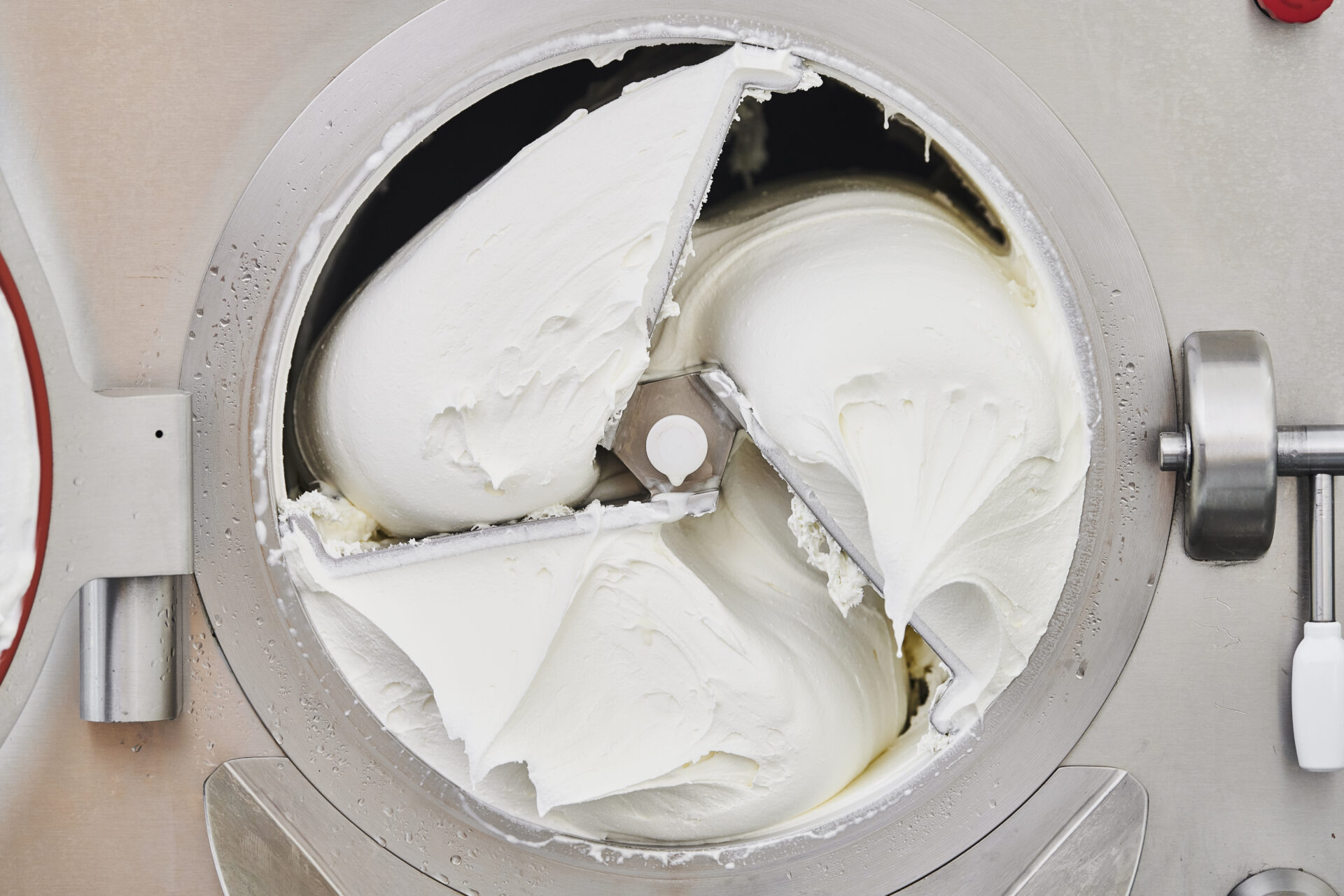
Additionally, we use what are known as “batch” ice machines, which are designed to produce only a limited amount—typically smaller portions—at a time. In our machines, we pour in 25 liters of ice cream or sorbet base at a time. The base is slowly frozen while a scraper with three arms rotates inside the machine, scraping ice from the cylinder-shaped wall and gently kneading it into a soft, creamy ice mass. This process happens without artificially adding air to the mixture. The only air in the ice comes naturally through the machine’s intake and is gently incorporated during the churning process.
In this way, just like traditional Italian gelato, we achieve a product with low air content and a very creamy consistency—something that cannot be accomplished using the “continuous freeze” method. That method is typically used in large-scale production, where the goal is to make as much ice cream as possible as quickly as possible.
At Kastbergs, we create ice cream and sorbet with strong inspiration from Italian gelato, but with a healthy dose of Danish craftsmanship, some of our own techniques and methods, and of course—primarily with local Danish ingredients.