Lundvej 8
7400 Herning, Denmark
joachim@kastbergs.dk
+45 2980 5400
CVR: 34224161
Blog
The History of IceCream and Sorbet
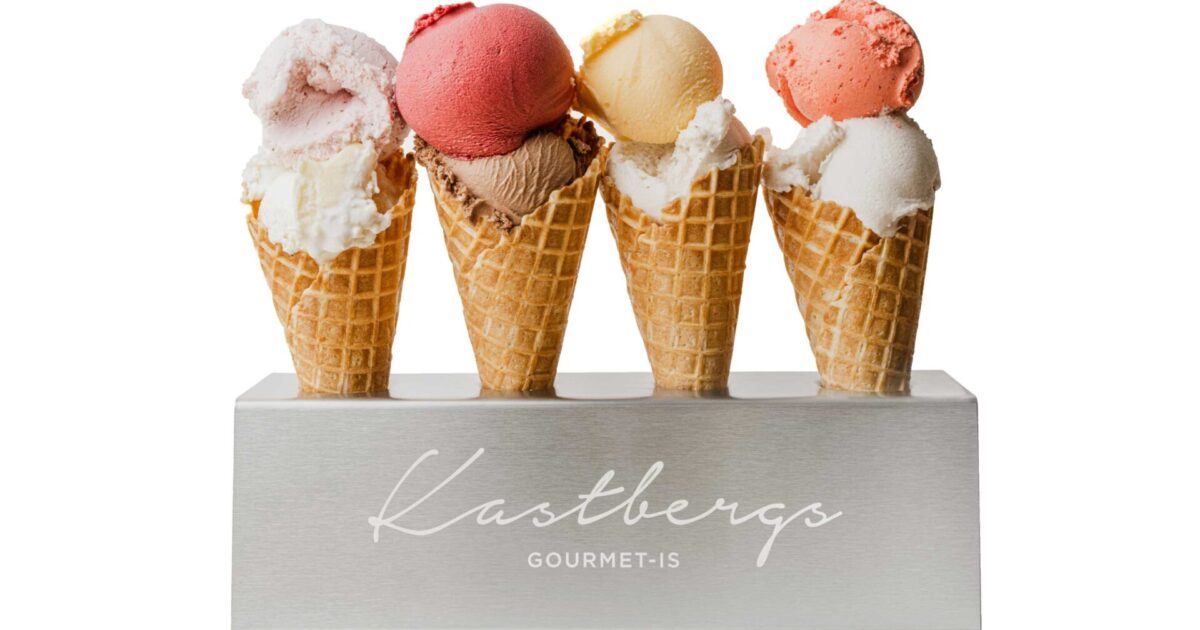
At Kastbergs, we work daily with ice cream and sorbet, and we thought it would be fitting to share the story behind these beloved treats.
The First Attempts at Ice Cream
Ice cream is a popular dessert loved worldwide, but did you know that its history dates back to ancient China? Ice cream, in its earliest form, wasn’t a dessert as we know it today, but rather a type of ice-drink, popular among the wealthy. These ice drinks were made from snow gathered by couriers from northern mountains, and ingredients like honey, fruit, and alcohol were often added to enhance the flavor. This was an early version of what we now call sorbet.
Historical accounts show that both Alexander the Great and, later, the Greeks and Romans used ice from the mountains to cool their drinks. In the early Roman Empire, it was also known that Emperor Nero was fond of fruit drinks mixed with honey and snow.
However, it is said that it wasn’t until around 1290 that Marco Polo returned from China with recipes for flavored ices, some even including milk, which marked the first real steps toward what we now know as modern ice cream.
A Scientific Approach
It’s difficult to pinpoint exactly when milk and cream were first incorporated into frozen desserts like ice cream. Some believe this approach originated in Asia and was introduced to Europe by Marco Polo, while others strongly argue that it is a myth.
To incorporate milk and cream into ice cream and other frozen desserts, chefs used an endothermic process. They would place the ice ingredients in a metal container, which was then placed in a bucket filled with ice and salt. The salt lowers the freezing point of ice, causing it to absorb energy and melt. The ice in the bucket would then “pull” heat from the ice mixture, which would freeze and turn into a more solid mass. The first evidence of this method dates back to 1550 when a Spanish doctor used the technique. Locals and newspapers described it as “Natural Magic.”
The doctor who first used the process said that since people typically wanted to drink wine as cold as ice, especially in the summer, he would teach them not only how to chill their wine but also freeze it so it could only be sipped. This method of freezing wine introduced the technique for making sorbet, and the first book on making sorbet was published in Italy in 1690.
The First European IceCreams
The first European ice creams are believed to have originated in Italy around the same time sorbet became popular. Recipes quickly spread from Italy to other European countries and to England, where the term “Ice cream” naturally originated.
The Growing Popularity of IceCream
For many years, unlike sorbet, ice cream was very labor-intensive to make, requiring many hours of manual work. Ice and snow still had to be gathered for the freezing process, and at the same time, the milk and cream mixture, along with flavorings, had to be hand-stirred for hours while freezing to create a creamy consistency. Because of the labor-intensive nature of ice cream production, it was also an expensive commodity and not something most people could afford.
In the 1700s, sorbet became increasingly popular in major European cities, where the growing middle class began enjoying the dessert in local shops. The earliest book dedicated solely to the making of ice cream was published in 1768 and was titled “True Principles of Freezing Refreshments.”
Ice Cream and Sorbet for the Masses
It was in the United States that ice cream and sorbet finally became accessible to the masses at an affordable price. A New Yorker named Nancy M. Johnson invented an ice cream machine that dramatically reduced production time. American companies built upon and improved her designs, simplifying and reducing the cost of ice cream production. In 1851, a milkman from Baltimore, Maryland, named Jacob Fussell started the first ice cream factories, further making ice cream products more widely available. Ice cream’s popularity exploded after the Civil War.
Freezing Facilities
While ice cream would seem impossible without modern refrigeration – early versions of ice cream were made possible by harvesting snow and ice from mountains and frozen lakes, which were well insulated for transport to reduce melting. Once the ice and snow arrived in cities, it was stored in so-called ice houses, which had deep pits that were free from light and heat and insulated to keep warmth out. Acquiring ice and snow was a highly manual process requiring much labor, making it a very valuable commodity. As such, ice was often reserved for the wealthy and aristocrats.
The first freezers were invented in the mid-to-late 1800s, making the production and storage of ice easier, though they were not particularly efficient. The gases and refrigerants used in early models were often toxic. Various gases and liquids were tested, and it wasn’t until Freon was discovered that refrigeration systems became widely used. Today, we use a gas called Tetrafluoroethane, which is non-toxic. Since the invention of the freezer over 100 years ago, it has undergone significant development, evolving from an exclusive luxury commodity to being commonly available in private homes after World War II. This increased availability made it much easier to store ice cream at home.