
10 Dutch desserts from markets and bakeries
The Netherlands doesn't have a reputation as Europe's great dessert nation in the way France or Austria do — but appearances deceive. Behind the simple façade lies a long list of Dutch desserts with roots in everything from humble country kitchens to colonial-era Batavia. What they share is that they are rarely elaborate. Instead, they are deeply rooted in everyday life: sold from a street stall, baked in a Dutch bakery or served at home with Sunday coffee. We have gathered ten of the most widespread and familiar Dutch desserts and sweet treats — from the world-famous stroopwafel to the multi-layered spekkoek. Several of them remain a staple of traditional Dutch recipes, passed down from generation to generation.
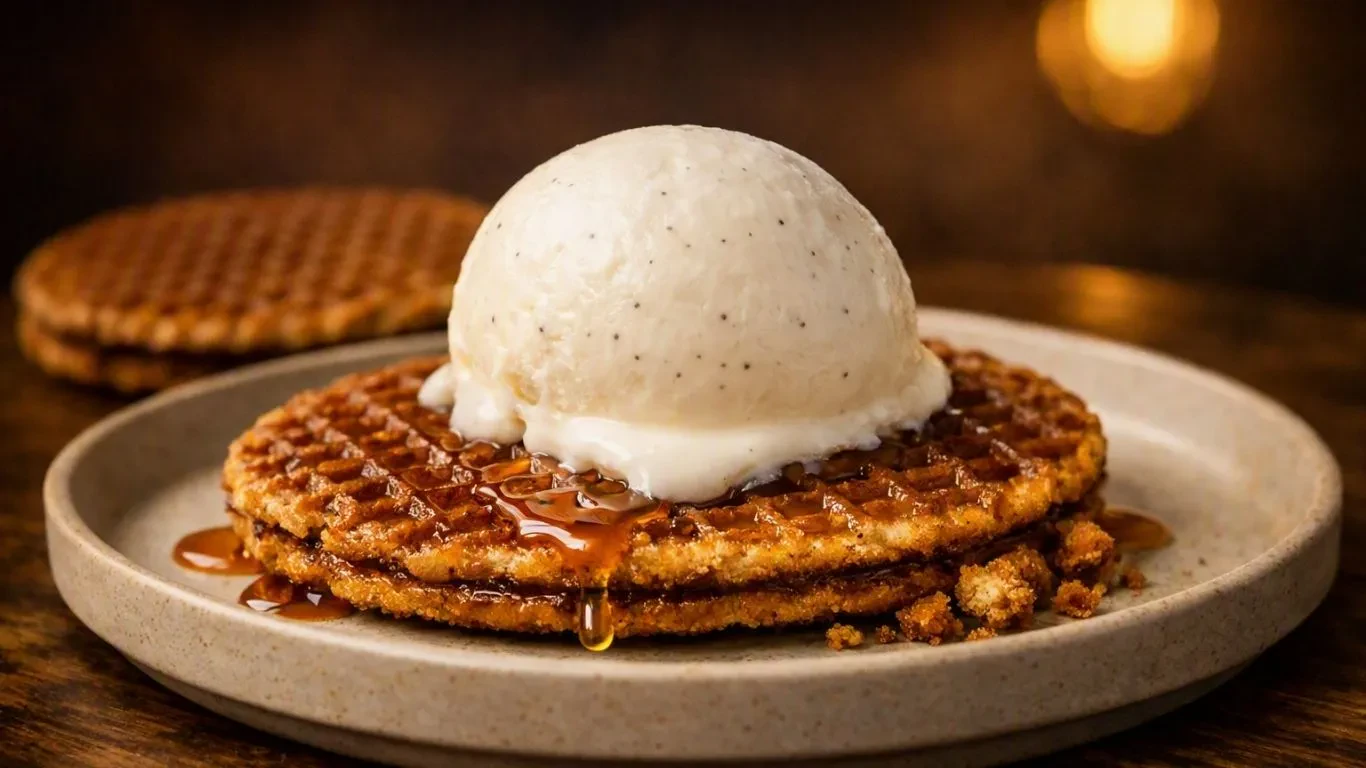
Stroopwafels – the Netherlands' best-known sweet export
The story of the stroopwafel stretches back to the late 1700s in the town of Gouda. According to tradition, a baker came up with the idea of boiling a syrup from the bakery's leftover crumbs and scraps of dough and spreading it between two thin, crisp waffles. What began as food for the poor is today the Netherlands' most recognisable sweet export.
The waffle has a firm place in Dutch homes: you lay it on top of a hot cup of coffee or tea for a couple of minutes, so the steam slowly softens the caramel syrup inside, before taking the first bite.
Poffertjes – the small, fluffy mini pancakes
Poffertjes have roots in French monasteries, but came to the Netherlands during the French Revolution, when Dutch bakers embraced the concept and developed it further with buckwheat flour and yeast. The dish quickly earned a firm place at Dutch markets in the 1800s, because the little pancakes could be baked fast on large copper pans with round indentations.
They are traditionally served hot and in big heaps, topped with a knob of butter and a thick layer of icing sugar — a classic comfort treat that is still sold from stalls at markets and kermesses.
Oliebollen – the Dutch New Year classic
The history of the oliebol goes a long way back, possibly to the Germanic tribes in the Netherlands, where similar deep-fried dumplings were reportedly eaten at winter feasts. The tradition has since become a fixture of Dutch winter cooking, and the explanation is simple: the rich, deep-fried yeast dumplings provided warmth and energy in the cold season.
Today the oliebol, often filled with raisins or pieces of apple, is inseparably linked with December and New Year's Eve. They are sold in large quantities from mobile street stalls (oliebollenkramen) in the weeks leading up to the new year.
Vla – the creamy Dutch everyday dessert
Vla dates back to the Middle Ages, when it was originally a thick, milk-based cream used to cover cakes. In the 1900s, Dutch dairies began selling it in cartons, which made vla an everyday dessert in Dutch homes.
The pourable vanilla or chocolate custard is typically eaten straight from the bowl — often as vlaflip, where vanilla and chocolate vla are carefully poured together with fruit syrup in stripes.
Tompouce – the pink cream pastry
Tompouce was created by a baker in Amsterdam in the 1800s, inspired by the French mille-feuille. According to the story, he named the square version after a circus performer who appeared under the name "General Tom Pouce". The pastry consists of two layers of crisp puff pastry with a firm layer of vanilla cream in between and a characteristic pink glaze on top.
On the Dutch King's Day (Koningsdag), bakeries across the country swap the pink glaze for orange — a small, annual detail that shows how closely the pastry is woven into Dutch everyday life and celebration.
Appeltaart – the deep Dutch apple cake
Appeltaart is one of the oldest known Dutch desserts, with a recipe that can be traced to one of the earliest printed Dutch cookbooks from 1514. Unlike French or American pies, it is baked in a deep springform tin with a firm, crisp shortcrust pastry spiced with cinnamon and filled with large pieces of tart apples, raisins and sometimes almond paste (spijs).
The cake is closely tied to hospitality and is served at pretty much every birthday, always accompanied by a big dollop of whipped cream (slagroom).
Speculaas – the spiced figure biscuits from the Dutch bakery
The history of speculaas is tied to the Netherlands' time as a trading nation in the 1600s, when the Dutch East India Company brought spices such as cinnamon, nutmeg, cloves, ginger and cardamom to the country. Bakers began mixing the spices into a shortcrust dough and pressing it into detailed wooden moulds.
The biscuits remain a fixture of the traditions around Sinterklaas in early December, when they are baked and eaten in large quantities in Dutch bakeries across the country.
Appelflappen – crisp apple triangles from the winter street stalls
Appelflappen has roots in the Dutch country kitchen, where apples from local orchards have always been close at hand. The simple but popular dessert consists of puff pastry filled with tart apple cubes, cinnamon and sugar, folded into a triangle, sprinkled with pearl sugar and baked until crisp.
It is traditionally sold side by side with the oliebol from street stalls in the winter months and eaten as a warm, crisp snack in the days leading up to New Year.
Wentelteefjes – the Netherlands' answer to French toast
The name wentelteefjes can be traced back several hundred years and refers to "turning" the bread in the pan. The dish arose as a practical answer to food waste: day-old, dry white bread was turned in a mixture of milk, egg and cinnamon and fried so it could be eaten again.
Today it is a classic weekend breakfast or a quick afternoon dessert, typically topped with dark Dutch brown sugar (basterdsuiker).
Spekkoek – the multi-layered spice cake
Spekkoek was developed in Batavia (present-day Jakarta) during the Dutch colonial era in Indonesia, where Dutch housewives tried to recreate European cakes using local Indonesian spices and techniques. The result is a cake built from as many as 20–30 paper-thin layers, baked one at a time under the oven's grill element.
The name literally translates as "bacon cake" and alludes to the striped layers. Today the cake has a firm place as the luxurious finale to a traditional Indisch-Dutch rijsttafel.
From Dutch pastry to the Danish dessert plate
What the ten desserts share is that they rely on patience and a small movement repeated until it feels right — the thin layers of a spekkoek, the right temperature of a poffertjes pan, the precise heat that makes a stroopwafel soften without falling apart. It is the same respect for technique and ingredients that guides our own work at Kastbergs.
Several of the classics can easily be reimagined on a Danish dessert plate: a scoop of vanilla ice cream next to a warm appeltaart, or a fresh sorbet to counter the sweet spiciness of speculaas. Find more ideas for how ice cream and sorbet can be brought into the dessert at kastbergs.dk/dessert-inspiration.